About the ACT Apricot
So what's so interesting about the Apricot? Let's start with the
physical design.
The case has a sliding front cover and a handle. The keyboard clips into
the bottom. And the monitor has a handle, too. It's luggable! I wouldn't
call it light, but you can definitely carry it. (Failing to carry it is
probably how mine got its huge gash in the side)
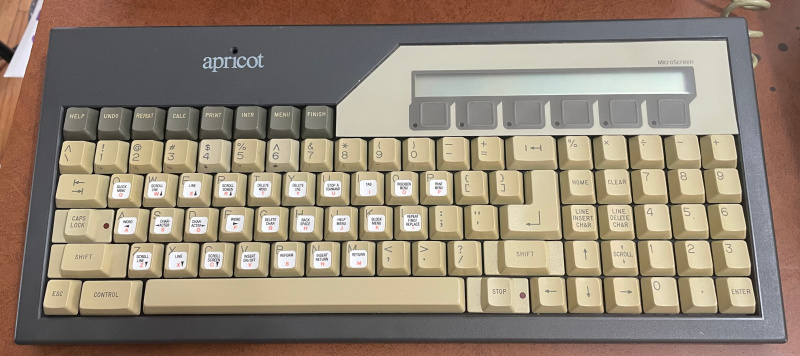
The keyboard has an unusual layout (mine has WordStar cheat labels) but
the most distinctive feature is the 40x2 character LCD display and
membrane keys. This provides software definable keys that can provide
shortcuts in things like WordStar or Lotus 123 (sadly the membrane on
mine is broken). The other weird thing about the keyboard is it keeps
time. The main unit has no timekeeping device, so on boot it reads the
time from the keyboard, which has its own 9V battery. It also has a
built-in calculator which can send results to the PC.
But when you look inside, things get even more interesting.
The 9 inch monochrome monitor has a resolution of 800x400. Text
characters are 10x16 pixels. Sharper than MDA and Hercules! But of
course there is no pixel pushing hardware in this machine, so I hope you
brought a well-tuned draw routine.
This was one of the first machines to use 3.5" floppy drives. The
original Apricot PCs shipped with Sony's original 70-track single-sided
drives, so you will find early software for the machine on 315K disks.
Later versions got the 80-track double-sided drives, so this example
uses a standard 720K format.
The later Xi was one of the first machines to use a 3.5" hard drive.
This example originally had a Rodime RO352, the first 3.5" hard drive on
the market. Other than its size, it's a standard 10MB MFM drive. It did
work at some point, but it is no longer in working condition.
The designers seem to have read more of the 8086 Family User's Manual
than IBM did, since this has not only the 8086 and its 16-bit data bus,
but also its companion 8089 IO Processor. The 8089 is sometimes called a
DMA controller, most likely by people who only understand the IBM PC
architecture. But it is a full-fledged processor with its own
instruction set. And what's really interesting for people who are used
to real mode, it uses FLAT 20-BIT ADDRESSING. As far as I'm aware, the
8089 is only used for disk access. And the way it's designed in this
system, it cannot be used as a parallel processor since it shares the
memory bus with the 8086.
Also differing from the PC, instead of the 8250 UART it uses the Z80
SIO. The SIO provides two serial channels up to 500Kbit/s and unlike the
8250, it also supports synchronous serial modes. The first channel is
used to talk to the keyboard, and the second connects to a standard
RS-232 port (or at least as standard as RS-232 gets). ACT sold a product
to network up to seven machines together, the Point 7. It used the
serial ports through a dedicated multiplexer.
And completely out of left field, there is the SN76489 Programmable
Sound Generator. If you're a retrocomputing fan, you might recognize
this chip from the Sega Master System/Game Gear, BBC Micro, PC Jr.,
Tandy 1000, or ColecoVision. It's an all time classic. And all ACT did
with it was generate keyboard clicks and system beeps. So I wrote the
APSG utility to change that.